Rural Arkansas is not where most people expect to find a model for the future of American public education. But that’s exactly what the Batesville School District has built.
A few years ago, Batesville was drowning. The district was running a $250,000 annual deficit, teacher salaries were among the lowest in the state, and the schools had become a revolving door — educators would get a few years of experience, then leave for better-paying districts. Superintendent Michael Hester inherited a budget problem and a retention crisis at the same time, two issues that usually make each other worse, not better.
Instead of cutting programs or asking taxpayers to bail out the district year after year, Batesville did something else: it looked at where its money was actually going. An energy audit revealed the district was spending over $600,000 a year on utilities — old HVAC systems, leaky windows, inefficient lighting, aging insulation. That’s not instruction. That’s not smaller class sizes. That’s just heat and electricity, leaking out of buildings older than most of the teachers working in them.
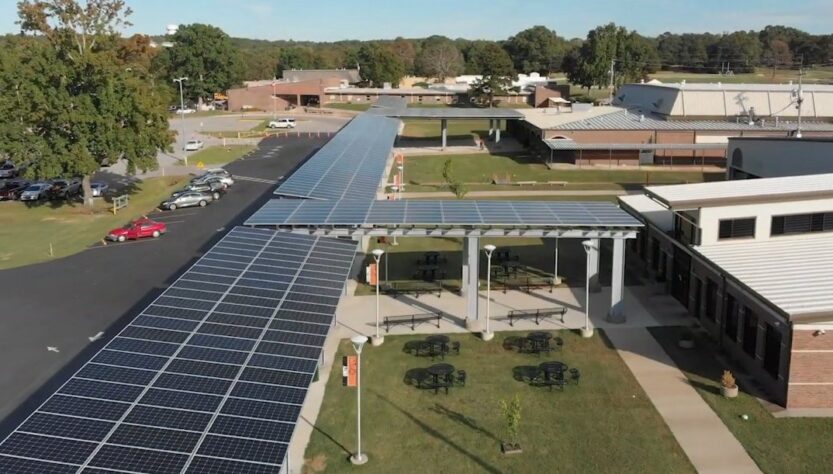
So the district financed a comprehensive retrofit: new lighting, new windows, upgraded HVAC, smart thermostats, and roughly 1,400 solar panels — some installed as a canopy over the school entrance, some on district land. Three years later, the $250,000 deficit had flipped into a $1.8 million surplus. Monthly utility bills fell from around $17,000 to $4,000. The panels started generating more power than the schools needed, and the district began selling the excess back to the grid.
Then came the part that made this story travel: the school board didn’t pocket the savings or quietly redirect them into unrelated line items. They voted, publicly and deliberately, to put the money into teacher pay. Raises averaged $2,000 to $3,000 a year, with some longer-tenured teachers seeing increases up to $15,000. Batesville went from one of the lowest-paying districts in its region to one of the highest-paying in its county. Resignations slowed. Applications went up. As one energy executive who worked on the project put it, Batesville reduced the checks it writes to utility companies and increased the checks it writes to teachers.
Why this deserves to be a model, not a headline
It’s easy to read this story as a nice, feel-good anecdote about solar panels. That undersells what actually happened here. Batesville didn’t ask taxpayers to fund a permanent new expense. It funded a one-time capital investment — the efficiency upgrades and panels — through a bond, and then let the resulting operational savings pay for something taxpayers already wanted: better-paid teachers and better-retained staff. The upfront cost was financed once. The savings compound every year after.
That’s a fundamentally different model than the usual choice districts face, which is either raise taxes or cut something. Batesville found a third option: stop paying an unnecessary bill and reroute that money to people instead of utility companies. At least 20 nearby districts have already copied the approach, and thousands of schools nationwide now have some form of solar on campus. But very few have gone the extra step Batesville did, of writing the savings explicitly into salaries rather than letting them dissolve into the general fund.
Every district sitting on aging HVAC systems, single-pane windows, and a utility bill that hasn’t been audited in a decade has a version of this option available to it. The math doesn’t require optimism — it requires an energy audit and the willingness to act on what it finds.
One caution: don’t pave over farmland or open space to get there
There’s a version of this story that goes wrong, and it’s worth naming so districts don’t stumble into it. Large ground-mounted solar arrays built on undeveloped land — especially farmland, forest, or natural habitat — trade one problem for another. Communities have increasingly pushed back on utility-scale solar projects that consume open land, and for good reason: converting productive or ecologically valuable land into a fixed-use energy site is a real tradeoff, not a free win.
Schools don’t need to make that tradeoff, because they’re usually sitting on the better solution already: rooftops and parking lots. A school district’s own buildings and pavement are typically the most underused real estate in town for this exact purpose. Solar canopies over parking lots do double duty — they generate power and give students, staff, and buses shaded parking, which in hot-climate states is its own quality-of-life upgrade. Rooftop arrays use space that’s otherwise doing nothing but holding up HVAC units. Neither requires clearing land, disturbing habitat, or taking farmland out of production.
Batesville’s own project actually leaned this direction already — its most visible installation is a canopy at the school entrance, not a sprawling field array. That’s the part of the model worth replicating most deliberately: build on what you’ve already paved over or roofed in, not what’s still growing something.
The takeaway
Batesville’s story isn’t really about solar panels. It’s about a district that treated its budget like something worth auditing, found real money being wasted on outdated infrastructure, and had the discipline to funnel the savings toward the people who actually do the work of educating kids — without asking taxpayers to shoulder an ongoing new cost to do it. That combination — fund the upgrade once, reinvest the savings forever, and site the panels on rooftops and parking lots instead of open land — is a genuinely replicable playbook. The only thing stopping most districts from trying it is not knowing it’s possible.
Now they do.
A rural Arkansas school district was hemorrhaging $250,000 a year and couldn't keep teachers. So residents voted to take out a $5.4 million bond, upgrade every building in the district, and install 1,400 solar panels.
— Give A Shit About Nature (@giveashitnature) July 3, 2026
Three years later, the deficit flipped to a $1.8 million… pic.twitter.com/xLn4bZnkET